
DINFIL High-Frequency Ground Filter
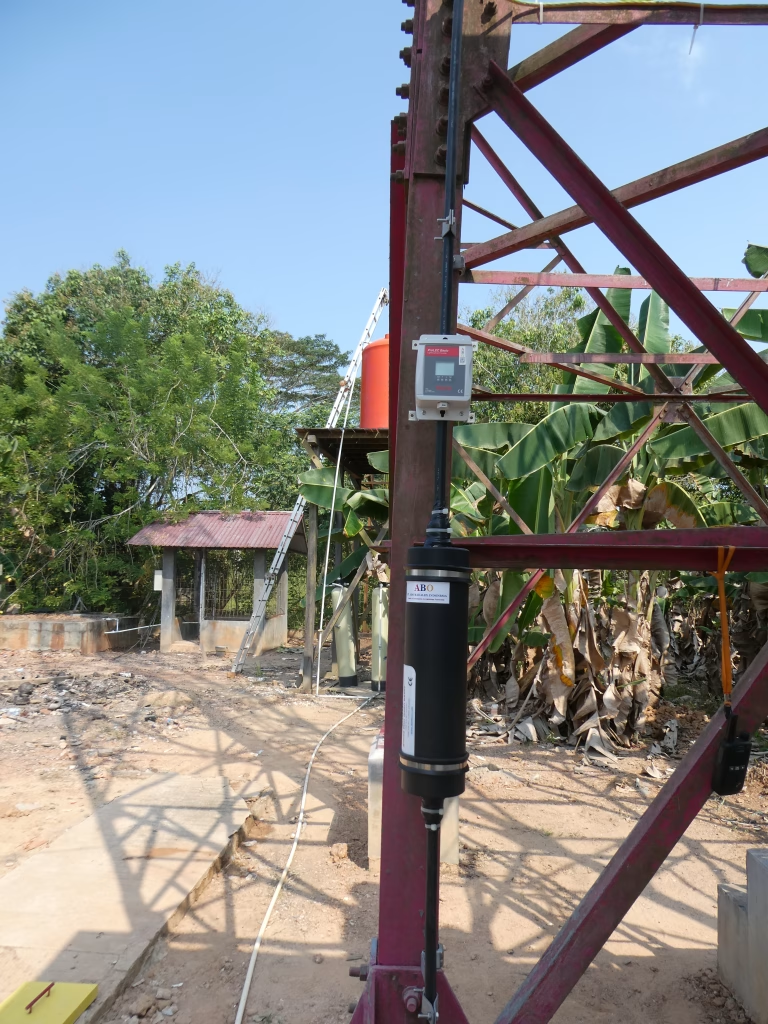
Grounding resistance isn’t the whole story.
A grounding electrode can have low measured DC resistance while connected equipment remains exposed to high-frequency disturbances travelling through the grounding network.
A lightning discharge can create rapid changes in earth potential. Those disturbances can propagate along grounding conductors and produce transient voltage differences at equipment connections.
Power-line SPDs protect their designated circuits. They do not address every disturbance that can arrive through other paths.
The Dinnteco DINFIL DNNFT is a high-frequency ground filter designed specifically for this problem.
How the DINFIL Ground Filter Works
DINFIL is installed in a designated grounding conductor between the equipment or equipotential bonding arrangement and the earth connection.
Inside the filter, a winding around a ferrite core produces inductive reactance.
The principle is straightforward:
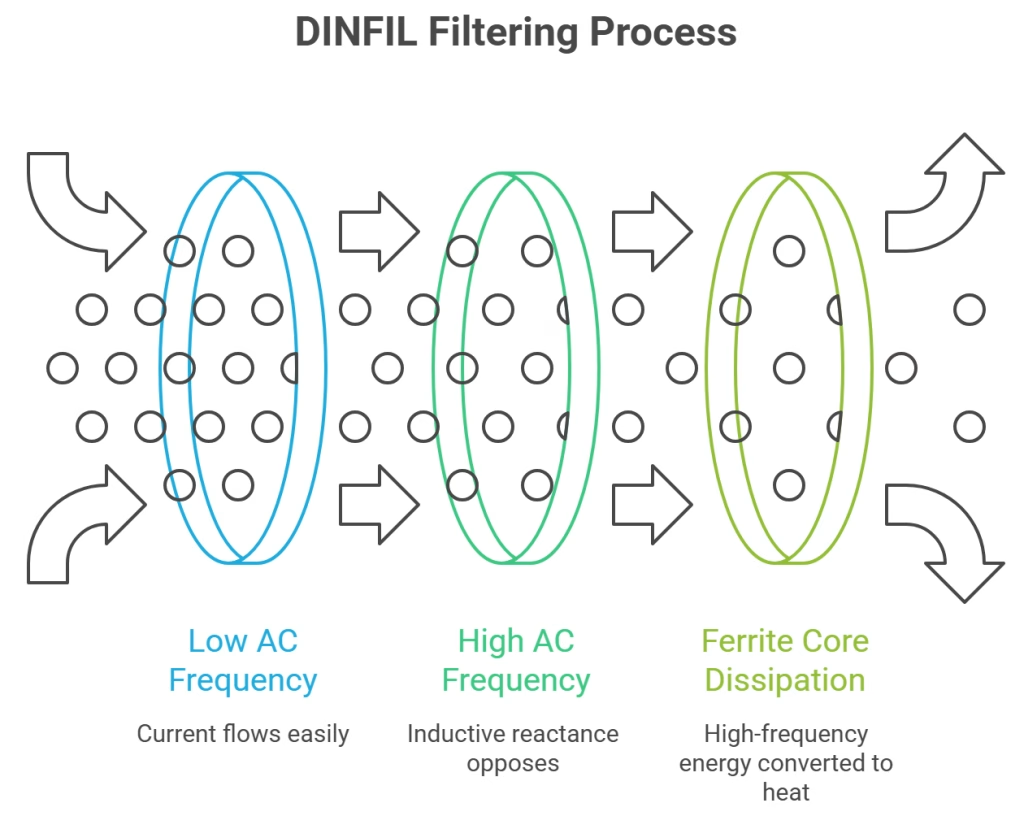
- At DC: The winding presents low electrical resistance.
- At low AC frequencies: Current can flow through the winding with comparatively low opposition.
- At high frequencies: Inductive reactance opposes rapidly changing current components, limiting their passage through the filtered path.
The ferrite core dissipates part of the high-frequency energy as heat.
This is frequency-dependent filtering, not the same operating principle as a conventional surge protective device.
The manufacturer’s catalogue describes the mechanism but does not publish an inductance value or attenuation-versus-frequency curve. Therefore, a specific attenuation figure cannot be stated from the available data.
One Critical Installation Rule
The grounding conductor of a conventional SPD must connect directly to ground—not through the DINFIL filter.
DINFIL is installed on the designated equipment or bonding-system grounding path according to the engineering design.
The SPD keeps its own direct grounding connection.
This arrangement is specifically addressed in Dinnteco’s installation diagrams.
The filter is not a replacement for equipotential bonding or for the SPDs required on power and communication circuits.
Tested for Lightning-Current Duty
Adding a frequency-selective filter to a grounding conductor creates an important engineering question:
Can it withstand high lightning impulse currents?
Dinnteco documents testing at the Official Central Laboratory of Electrotechnics (LCOE), Getafe, Madrid.
100 kA Impulse Testing
The catalogue reports tests using a 100 kA (10/350 µs) lightning impulse waveform in accordance with IEC 62561-1 requirements.
The tested samples showed no visible damage, with measured contact resistance remaining below 1 mΩ.
200 kA Impulse Testing
The filter also passed a separate high-current impulse test programme using a nominal 200 kA (10/350 µs) waveform.
Three reported impulses reached approximately 218–224 kA, accumulating more than 30 MJ/Ω of specific energy.
Additional charge-transfer testing recorded more than 2,400 C across multiple successive events, exceeding the accumulated charge requirement documented for winter lightning exposure.
These results demonstrate lightning-current withstand performance under the reported laboratory test conditions.
They are not a frequency-response measurement and do not mean the device completely blocks a lightning impulse.
Technical Specifications
| Specification | Value |
|---|---|
| Manufacturer | Dinnteco |
| Model | DNNFT / DINFIL |
| Product Type | High-frequency ground filter |
| IEC 62561-1 Classification | Class H (Heavy Duty) |
| DC Resistance, 10 A Test | 0.37 mΩ |
| Resistance After 100 kA Tests | 0.37–0.49 mΩ across reported samples |
| Lightning Current Testing | 100 kA (10/350 µs) |
| High-Current Impulse Testing | 200 kA (10/350 µs) |
| Accumulated Specific Energy | Greater than 30 MJ/Ω |
| Accumulated Charge Transfer | Greater than 2,400 C |
| Approximate Length | 17 11/16 in (449 mm) |
| Approximate Diameter | 3 7/8 in (98 mm) |
| Approximate Weight | 11.02 lb (5 kg) |
| Cable Diameter Range | Up to 5/8 in, with specified accessory configuration |
| Clamping Screws | M8 × 10 |
| Tightening Torque | 8 Nm |
| Materials | Copper, ferrite, POM and dielectric insulator |
What does Class H mean?
Class H is the heavy-duty connection-component classification under IEC 62561-1, associated with 100 kA lightning impulse testing.
Documented Laboratory Reports
| Standard Referenced | LCOE Report |
|---|---|
| IEC 62305-1 | 2019033F0172 |
| IEC 62561-1 | 2020073F0309 |
| IEC 61400-24 | 2021093F0356 |
Download DINFIL DNNFT Technical Catalogue
Where Is DINFIL Used?
Telecommunications Towers
A tower’s grounding network connects exposed metallic structures, lightning protection components, equipment shelters, and sensitive telecommunications systems.
High-frequency disturbances can propagate through these connections. DINFIL provides a filtering option for specifically designed grounding branches.
Wind Turbines
Wind turbines operate in exposed locations where grounding and lightning protection are central design concerns.
DINFIL has documented test results referencing IEC 61400-24, including high-current impulses and accumulated charge transfer associated with lightning exposure.
Railway Signalling Infrastructure
Railway signalling installations often contain distributed electrical equipment connected through extended wiring and grounding networks.
Where high-frequency earth-borne disturbances are identified as a protection concern, the filter can be incorporated into the appropriate grounding branch.
Low Resistance and High-Frequency Impedance Are Different Problems
A conventional grounding resistance test tells you something about the electrode-to-earth connection.
It does not provide a complete description of the grounding system’s response to fast transient currents.
For background, read Standar Nilai Grounding yang Baik (In Indonesian) on the factors affecting grounding resistance.
Our LinkedIn post on grounding versus earthing also discusses why one grounding measurement cannot describe every aspect of electrical protection.
Related Protection
DINFIL complements, rather than replaces, conventional surge protection.
For equipment connected through Ethernet cabling, see the Sankosha LAN-1000IS-2 Gigabit Surge Protector, which addresses a different surge entry path.
Installation and Maintenance
Dinnteco’s installation guidance covers configurations for telecommunications towers, electrical equipment, marine installations, and equipotential bonding arrangements.
The filter can be mounted vertically or horizontally using appropriate supports.
The manufacturer requires annual maintenance by an official installer, with the maintenance work documented under its prescribed protocol.
The catalogue does not provide a complete step-by-step maintenance checklist or quantitative frequency-response data.
Where Should the Filter Go in Your Grounding System?
Send PT ABO Madalex Indonesia:
- The type of site and equipment being protected
- Your grounding and equipotential bonding diagram
- The locations of existing SPDs
- The electrical disturbance or equipment failure you are trying to address
We’ll help determine whether DINFIL suits the identified problem and where it belongs in the grounding arrangement.
View DINFIL DNNFT Test Results and Installation Diagrams