
ProTec AQS 40 : Surge Protector for Overhead Power Lines
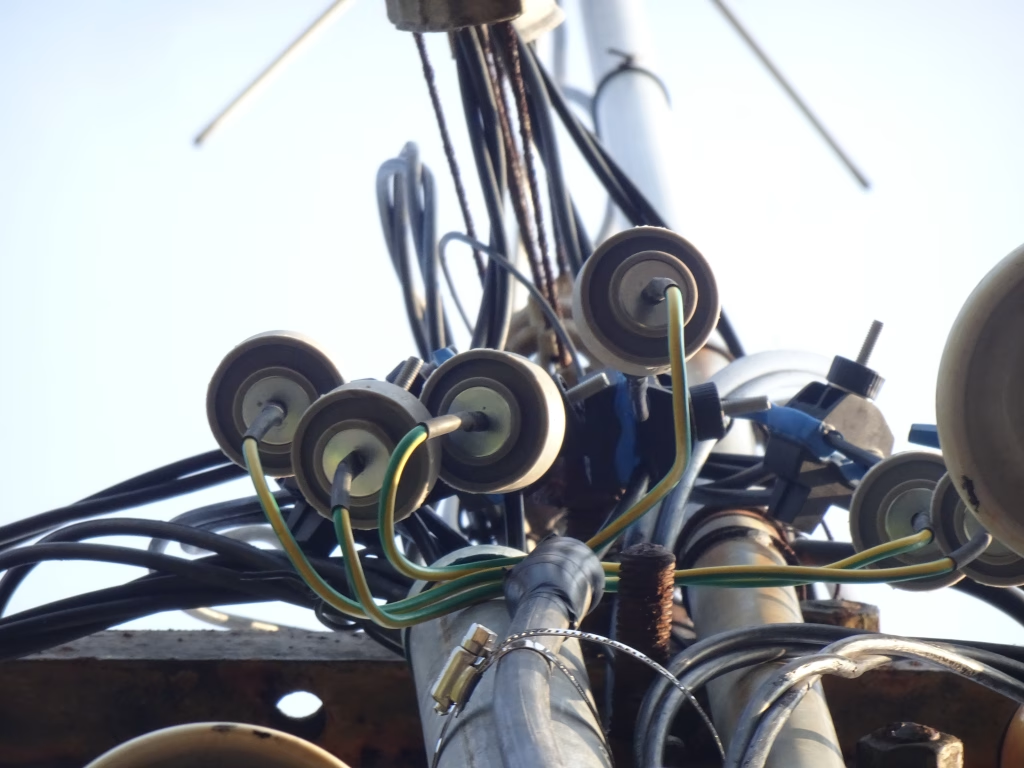
Overhead-line surge protection where its fail condition is visible from the ground.
Lightning-induced surges can enter low-voltage distribution networks through overhead conductors and affect connected equipment, including meters, power supply equipment, and customer installations.
For utilities and infrastructure operators, the challenge is not just limiting these transient overvoltages.
It’s also knowing when a protective device has reached the end of its service life.
The Solution: Raycap ProTec AQS 40
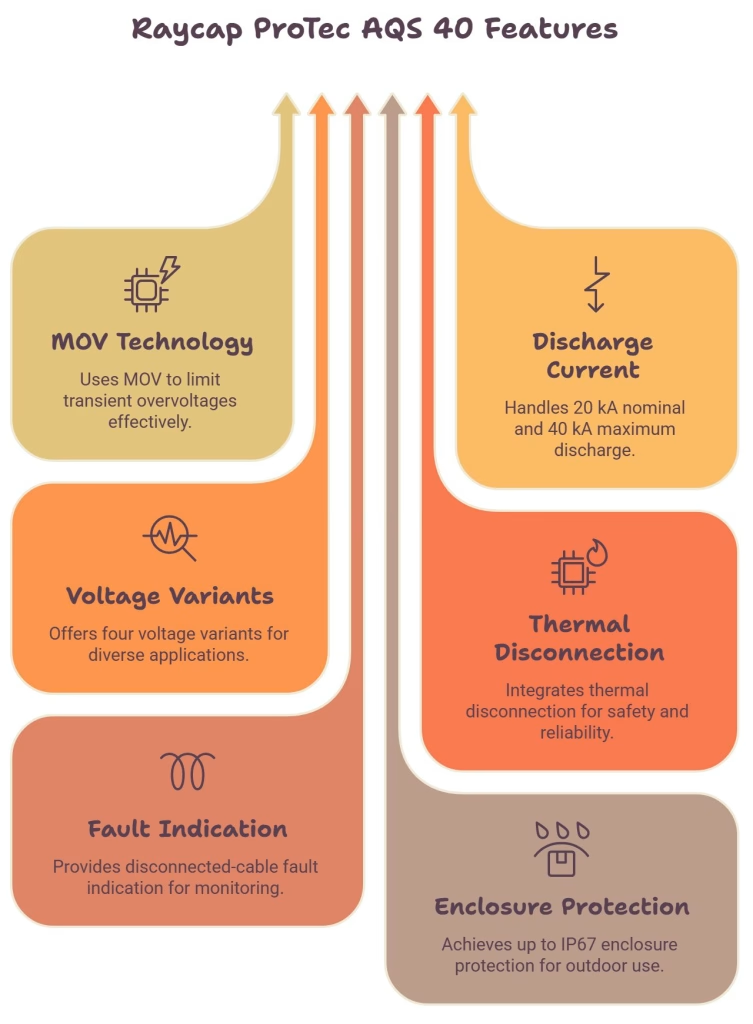
The Raycap ProTec AQS 40 is a compact, single-pole Class II / Type 2 surge protective device designed for low-voltage overhead power lines.
It uses a high-energy metal oxide varistor (MOV) to limit transient overvoltages between the protected conductor and protective earth.
The device provides:
- 20 kA nominal discharge current (8/20 µs)
- 40 kA maximum discharge current (8/20 µs)
- Four voltage variants
- Integrated thermal disconnection
- A disconnected-cable fault indication
- Up to IP67 enclosure protection
Its construction is intended for outdoor power distribution applications.
A Thermal Disconnector That Indicates Failure
Surge protective devices can deteriorate after repeated or severe electrical stress.
ProTec AQS 40 incorporates a thermal disconnection arrangement that separates the protective element when the device reaches the relevant failure condition.
The disconnected cable provides an external indication that the unit requires attention.
This is particularly useful for overhead-line installations, where inspecting a protective device’s internal components is not practical.
The catalogue confirms the disconnected-cable indication. However, whether that indication can be reliably identified from ground level depends on the installation position and visibility; no guaranteed ground-level inspection distance is specified.
Choosing the Correct Voltage Variant
The ProTec AQS 40 Series is available in four voltage variants.
| Specification | AQS 40/150 | AQS 40/275 | AQS 40/320 | AQS 40/440 |
|---|---|---|---|---|
| Nominal AC Voltage (Uo) | 120 V | 230 V | 230 V | 440 V |
| Maximum Continuous Voltage (Uc) | 150 V | 275 V | 320 V | 440 V |
| Voltage Protection Level (Up) | <0.9 kV | <1.3 kV | <1.4 kV | <2.0 kV |
| TOV Withstand, 5 Seconds | 216 V | 393 V | 393 V | 682 V |
| Order Code | 509.210 | 509.211 | 509.212 | 509.213 |
All four variants have a nominal discharge-current rating of 20 kA and maximum discharge-current rating of 40 kA, both using the 8/20 µs waveform.
Which Variant Fits a 220/230 V Network?
The AQS 40/275 and AQS 40/320 are both listed for a nominal 230 V supply.
Their main differences are the maximum continuous operating voltage and voltage protection level.
- AQS 40/275: Uc 275 V, Up below 1.3 kV.
- AQS 40/320: Uc 320 V, Up below 1.4 kV.
The 275 V variant has a lower stated voltage protection level, while the 320 V variant allows a higher continuous operating voltage.
The correct choice depends on the actual supply characteristics, possible sustained overvoltage conditions, and equipment insulation requirements.
The 440 V variant is listed with both nominal and maximum continuous voltages of 440 V. This is reproduced from Raycap’s catalogue and should be confirmed against the current manufacturer datasheet when specifying that model.
Technical Specifications
| Specification | Value |
|---|---|
| Manufacturer | Raycap |
| Series | ProTec AQS 40 |
| Classification | Class II / Type 2 |
| Protective Element | High-energy MOV |
| Nominal Discharge Current (8/20 µs) | 20 kA |
| Maximum Discharge Current (8/20 µs) | 40 kA |
| Response Time | Less than 25 ns |
| Number of Ports | 1 |
| Protection Modes | L–PE / N–PE |
| Network Systems | TN; TT for L–PE application |
| Temperature Range | −40°C to +85°C |
| Permissible Humidity | 5–95% |
| Enclosure Protection | Up to IP67 |
| Housing Material | Silicone |
| Thermal Protection | Yes |
| Fault Indication | Disconnected cable |
| Connection Thread | M8 |
| Maximum PE Conductor Cross-Section | 6 mm² |
| Maximum Screw Torque | 3.5 Nm |
| Referenced Standards | IEC 61643-11:2011 / EN 61643-11:2012 |
The catalogue specifies a response time below 25 ns, but the installed protection performance also depends on connecting conductor length and layout.
Download ProTec AQS 40 Technical Catalogue
Where Is ProTec AQS 40 Used?
Transformer Low-Voltage Connections
An SPD can be positioned on the low-voltage distribution network associated with a transformer to limit transient overvoltages appearing on the connected conductors.
Residential Service Connections
Overhead service conductors can expose connected installations to lightning-induced transient overvoltages.
The AQS 40 provides a compact SPD option for suitably designed distribution connections.
Railway 220 VAC Distribution Networks
Raycap’s installation material supplied by ABO includes examples of AQS devices installed on railway overhead electrical supply networks.
These installations illustrate how protection devices can be incorporated at selected points in the distribution system.
Single-Phase and Three-Phase Installation
ProTec AQS 40 is a single-pole SPD.
Each device protects the conductor-to-earth path for which it is connected.
The number of devices required depends on the network configuration and which conductors require protection.
Raycap’s catalogue identifies L–PE and N–PE protection modes and specifies the network systems for which the device is intended.
A complete three-phase arrangement may therefore require several devices, rather than one AQS 40 protecting every conductor.
[Editor: Insert the single-phase installation diagram from AQS 40 Full.pdf, page 5.]
[Editor: Insert the three-phase installation diagram from the same page beside it. Retain conductor labels and the earthing arrangement.]
These diagrams illustrate the conductor connections and positioning of the devices on overhead-line installations.
The actual arrangement should follow the supply system’s TN or TT earthing configuration and applicable electrical installation requirements.
Installation Accessories
The ProTec AQS series uses connection accessories for overhead-line mounting.
Raycap’s low-voltage protection catalogue lists:
- Fixing cable
- Fixing hook
- PSN connection clamp for non-insulated conductors
- PSI connection clamp for insulated conductors
The connection hardware must match the conductor type and installation arrangement.
One More Detail: The Ground Connection Matters
The SPD’s voltage protection level is not the only factor determining the voltage experienced by connected equipment.
The connecting conductors introduce additional voltage during fast surge currents.
Keeping these connections properly arranged is part of achieving effective installed protection.
For installations with difficult grounding conditions, see M-EARTH Grounding Resistance Reducer.
For an introduction to arrester selection, read our article, Manfaat Arrester untuk Perlindungan Infrastruktur dari Bahaya Petir (In Indonesian).
We also discuss the financial consequences of equipment damage and downtime in our LinkedIn post on calculating lightning-related losses.
Specify the Right AQS 40 for Your Network
Send PT ABO Madalex Indonesia:
- Your network voltage
- Earthing system (TN or TT)
- Single-phase or three-phase configuration
- Overhead conductor type (insulated or bare)
- Proposed protection location
We’ll review the required voltage variant, protection paths, quantity, and connection accessories for the installation.
Request AQS 40 Product Selection
Download ProTec AQS 40 Technical Catalogue